
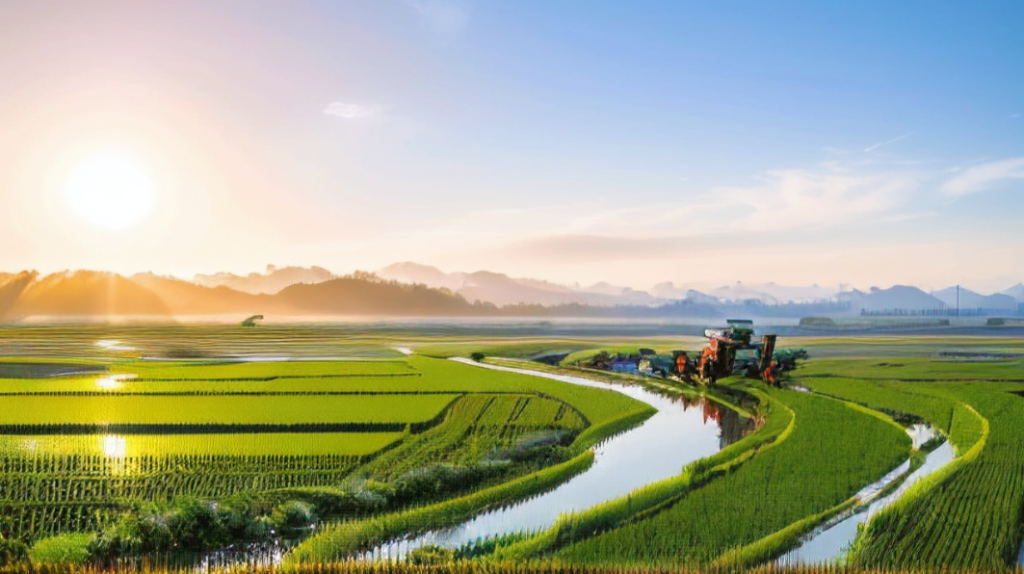
Rice is one of the world’s most important staple crops, feeding billions of people every day. As labor shortages, rising production costs, and increasing demands for food security continue to challenge agricultural production, mechanized rice cultivation has become essential for improving productivity and sustainability. Among the most significant innovations in rice farming is the rice transplanter, a machine that has transformed the traditional transplanting process and accelerated the modernization of rice production.
The Evolution of Rice Transplanting
Traditionally, rice seedlings were transplanted manually, requiring large amounts of labor and time. This process was physically demanding and often resulted in inconsistent planting depth and spacing, affecting crop growth and yield.
The introduction of rice transplanters revolutionized this stage of production. By automating the transplanting process, farmers can significantly reduce labor requirements while achieving more uniform planting patterns. Today, rice transplanters have become a key component of modern rice farming systems across Asia and other rice-producing regions.
How Rice Transplanters Improve Farming Efficiency
Modern rice transplanters are designed to plant seedlings quickly, accurately, and consistently. The machine automatically picks up seedlings from nursery trays and places them into prepared paddy fields at predetermined intervals.
This technology offers several important advantages:
- Reduced labor dependency
- Higher planting efficiency
- Consistent planting depth
- Uniform row spacing
- Improved field management
- Enhanced crop establishment
By ensuring precise seedling placement, rice transplanters create favorable growing conditions that support healthy root development and improved crop performance.
Precision Agriculture and Smart Transplanting
As agriculture enters the era of digitalization, rice transplanter technology continues to evolve. Advanced models now integrate intelligent control systems, GPS positioning, automatic steering, and data-driven management functions.
These innovations enable operators to achieve greater planting accuracy while reducing overlap and missed areas. In autonomous or semi-autonomous systems, machines can follow predefined routes and maintain consistent operating performance even under challenging field conditions.
The integration of smart technologies not only improves operational efficiency but also provides valuable field data that can support future crop management decisions.
Supporting Sustainable Rice Production
Sustainability has become a major focus in modern agriculture. Efficient planting practices help optimize resource utilization and reduce unnecessary inputs throughout the growing cycle.
Accurate transplanting can contribute to:
- Better fertilizer utilization
- Improved water management
- Reduced seedling waste
- Lower fuel consumption
- Higher land-use efficiency
These benefits help farmers achieve higher productivity while minimizing environmental impact, supporting long-term agricultural sustainability.
The Future of Rice Transplanter Technology
The next generation of rice transplanters is expected to feature even higher levels of automation, connectivity, and intelligence. Artificial intelligence, machine vision systems, autonomous navigation, and cloud-based farm management platforms are rapidly reshaping the agricultural machinery industry.
Future rice transplanters will not only perform planting operations but also become integrated components of smart farming ecosystems, communicating with other agricultural equipment and management systems to optimize field performance throughout the entire production cycle.
Conclusion
Rice transplanters have become indispensable tools in modern rice farming, helping producers improve efficiency, reduce labor requirements, and achieve more consistent crop establishment. As technology continues to advance, intelligent and autonomous transplanting solutions will play an increasingly important role in supporting global food production and driving the future of smart agriculture.
Through continuous innovation in agricultural machinery, rice transplanter technology is helping farmers around the world cultivate rice more efficiently, sustainably, and profitably than ever before.